

Trading Selection ⭐4.1/5
App / UX ⭐4.0/5
Bonus / Promos ⭐2.8/5
Customer Support ⭐4.3/5
Robinhood Promo Code: No Welcome Bonus
Must be 18 years or older and have a legal, U.S. residential address within the applicable state, D.C., or U.S. territories. Not available in AZ, IL, MA, MD, MI, MT, NJ, NV and OH.

Robinhood needs no introduction as a brokerage. Since launching in 2013 it democratised stock trading by removing commissions and making investing accessible to a generation that had never opened a Charles Schwab account. The prediction markets feature, launched in early 2025 through Robinhood Derivatives LLC, a CFTC registered futures commission merchant and NFA member, followed the same logic to take something that existed but was hard to access, simplify it, and put it where millions of people already are.

No Welcome Bonus
The prediction markets hub sits inside the Robinhood app alongside stocks, options, and crypto. For anyone who already has a funded Robinhood account, getting into event contract trading is a matter of opening a Derivatives account and tapping one additional tab. The platform runs in partnership with Kalshi, whose exchange infrastructure powers many of the available contracts, meaning users on both platforms often see the same markets with the same pricing.
What Robinhood offers is not the deepest or most specialist prediction market experience available. What it offers is the most convenient one, for a very specific user that someone already inside the Robinhood ecosystem who wants event contract trading without the friction of signing up somewhere new.
How Robinhood Prediction Markets Work
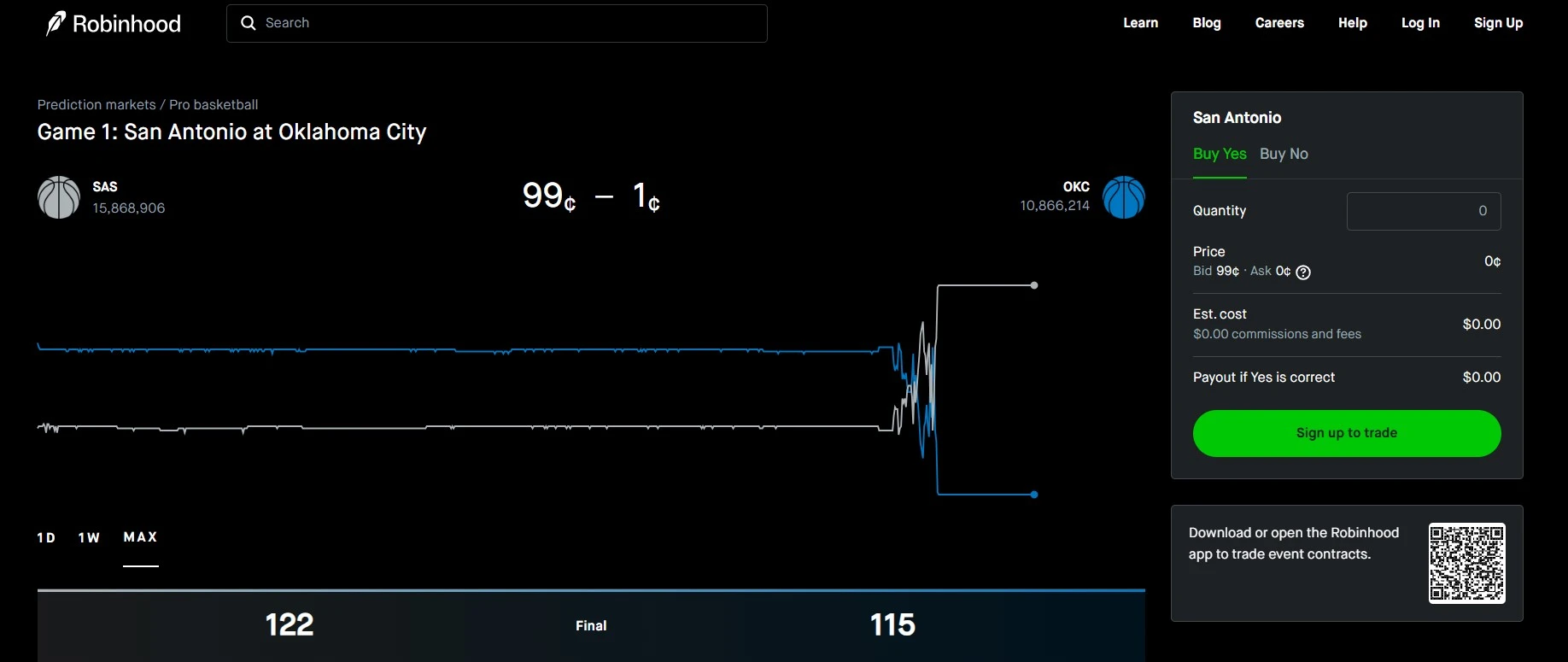
Robinhood prediction markets are built around Yes/No event contracts. Every market asks a specific question about a real world outcome, such as which team wins a game, whether the Fed raises rates, or who leads a country at the end of the year. You buy Yes if you think it will happen or No if you think it will not. Each contract is priced between $0.01 and $0.99, reflecting the probability the market collectively assigns to that outcome. A contract at $0.58 means the market believes there is a 58% chance the event resolves Yes.
If you are right and hold through settlement, each contract pays $1. If you are wrong, it expires at $0. You can also close your position before the event resolves by taking the opposite side of your original trade, selling your Yes contracts if you originally bought Yes, which locks in whatever gain or loss has accumulated since you entered.
To access prediction markets, you first need a standard Robinhood investing account and then a separate Robinhood Derivatives account. Opening the Derivatives account takes a few additional days and requires a separate application. This is a meaningful extra step compared to platforms built specifically around prediction markets, where the trading account and the event contract account are one and the same.
Once your Derivatives account is open, you fund it via debit card, bank transfer, wire, or instant deposit. There is no minimum deposit. ACH and debit card deposits are free. Wire transfers carry a $25 fee from Robinhood's side.
When a market settles, contracts resolve automatically. Winning contracts pay $1 per share to your Derivatives account balance. Funds can then be withdrawn back to your linked bank account. Withdrawals are processed without a fee though processing can take several business days depending on the method used.
Platform Snapshot
⭐ Best For: Existing Robinhood users wanting event contract trading inside their current app
🎁 Welcome Offer: Free stock worth $5 to $200 on account signup (not specific to prediction markets)
📍 Availability: Most U.S. states; sports contracts restricted in Maryland, Nevada, and New Jersey
📚 Market Categories: Sports, politics, economics, culture, climate, technology, metals, FX
💰 Payment Methods: Debit card, bank transfer, wire, instant deposit, crypto transfer
Behind the Platform

Robinhood was founded in 2013 by Vlad Tenev and Baiju Bhatt and is headquartered in Menlo Park, California. The company went public on the Nasdaq in July 2021 under the ticker HOOD. Prediction markets are offered through Robinhood Derivatives LLC, a CFTC registered futures commission merchant and swap dealer and NFA member. The product launched in early 2025 and is available across most U.S. states, with sports contracts restricted in Maryland, Nevada, and New Jersey. Event contracts on Robinhood are powered in partnership with Kalshi, whose exchange infrastructure underpins many of the available markets. The minimum deposit is $1 with no Robinhood side deposit fee.
Platform Profile
| Founded | 2013 |
| Founders | Vlad Tenev and Baiju Bhatt |
| Headquarters | Menlo Park, California, USA |
| Supported Countries | United States (most states) |
| Asset Types | Binary event contracts (Yes/No) |
| Fees (summary) | $0.02 per contract ($0.01 to Robinhood, $0.01 to Kalshi); no deposit fees; $25 wire fee |
| Regulation Status | CFTC regulated via Robinhood Derivatives LLC (registered FCM and NFA member) |
| Exchange Partner | Kalshi |
| Stock Ticker | HOOD (Nasdaq) |
What You Can Trade and What Stands Out
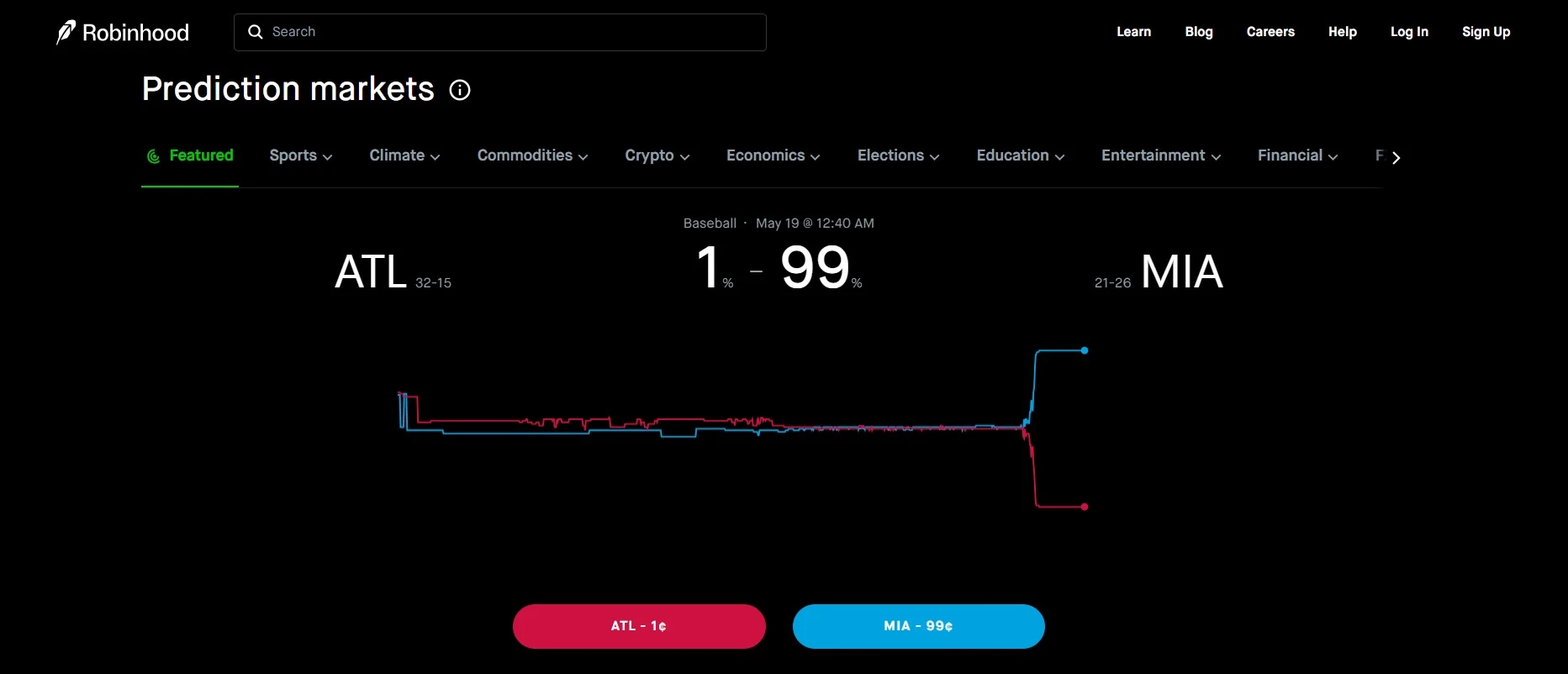
Market Categories
Sports: NFL, NBA, MLB, NHL, NCAAF, NCAAB, boxing, soccer, golf, racing, and esports. One of the most extensive sports catalogs available on any regulated prediction market platform, covering not just major leagues but one off events like the 2026 Winter Olympics and 2026 World Cup.
Politics: U.S. elections, congressional votes, presidential decisions, state races, and international political events. Markets include specialty political questions beyond just who wins an election, covering margin of victory, nomination outcomes, and specific legislative events.
Economics: Fed rate decisions, inflation, unemployment, GDP growth, and stock market direction markets. Macro data traders will find a well developed category here.
Culture: Grammy, Oscar, and Golden Globe markets, music chart outcomes, streaming milestones, Google search results, and social media events. One of the most detailed entertainment sections in the regulated prediction market space.
Climate: Daily temperature markets, rainfall contracts, and seasonal weather outcomes. These short duration markets resolve quickly and attract active participation.
Technology: AI model rankings, tech company milestones, and product launch outcomes.
FX: Currency pair contracts covering USD/JPY, EUR/USD, and GBP/USD exchange rate levels at specific dates.
Metals: Gold, silver, platinum, and palladium price level contracts.
Trading Model
Order Book Exchange: Peer to peer contracts powered by Kalshi's infrastructure
Binary Contracts: Every market resolves at $1 (Yes) or $0 (No)
Market and Limit Orders: Both available through the order flow
Position Management Tools: Voluntary trading breaks, position limits, and self exclusion available
24/7 Trading: Markets are accessible around the clock
What Makes It Stand Out
The market catalog is genuinely one of the most varied in the space. With over 1,600 active markets available during testing, Robinhood covers categories that most dedicated prediction market platforms do not touch, including FX rates, metals pricing, individual weather events, esports outcomes, and detailed entertainment contracts. The breadth of what you can trade on a given day is a real advantage over platforms with narrower catalogs.
The Kalshi partnership creates shared liquidity on overlapping markets, which means pricing efficiency on major contracts is competitive with what you would find on Kalshi directly. For users who do not want two separate accounts, being able to access that liquidity through Robinhood alone is a meaningful convenience.
The responsible trading tools are also worth noting. Robinhood offers voluntary trading breaks, self exclusion from prediction markets, and position caps, features that most standalone prediction market platforms do not have. For traders who want guardrails built into the platform itself, this is a genuine distinctive feature.
Markets Moving Right Now
Most Active Contracts
Robinhood's highest volume markets in 2026 have included:
- NFL, NBA, and MLB game outcomes and player props
- Federal Reserve rate decision markets
- U.S. midterm and presidential race futures
- Bitcoin and Ethereum price milestone contracts
- Climate markets including daily temperature and rainfall contracts
- FX rate contracts on major currency pairs
Where the Liquidity Sits
Major sports events, Fed meeting days, and primary season political markets attract the most volume and tightest pricing. Climate and FX markets see strong activity given their short resolution windows, which appeal to traders who want contracts that settle quickly rather than waiting weeks or months.
Fastest Moving Markets
Prices tend to shift most sharply around:
- Live sports events, particularly during play off rounds
- Breaking political news and polling shifts
- Fed announcements and CPI data releases
- Crypto price swings
- Weather event days for climate contracts
Most Active Categories
Sports, Politics, Economics, Culture, Climate, Technology, FX, Metals
What It Costs to Trade
Trading Fees
Robinhood charges $0.02 per contract, split evenly between Robinhood and Kalshi at $0.01 each. This flat per contract fee applies on both sides of a trade, opening and closing. For a trader who buys and then sells before settlement, the total round trip cost is $0.04 per contract. For traders who hold through settlement and win, the same $0.02 applies on entry only, with no additional settlement charge on the winning side.
The flat fee structure is simple and easy to calculate in advance. Compared to Kalshi's variable formula which can reach $1.75 per 100 contracts for takers, Robinhood's $0.02 per contract works out to $2.00 per 100 contracts regardless of where the contract is priced. For contracts near the extremes where Kalshi fees drop to near zero, Robinhood's flat rate is comparatively higher. For mid range contracts around $0.50, where Kalshi fees are at their peak, Robinhood's flat rate is more competitive.
Deposit and Withdrawal Fees
ACH and debit card deposits are free. Wire transfers carry a $25 fee. There is no minimum deposit. Withdrawals are processed without a fee from Robinhood's side, though processing times can run several business days for standard bank transfers. Instant deposit is available for faster access to funds.
Spreads
On major sports events and headline political markets, spreads are tight thanks to the shared Kalshi liquidity pool. Markets outside the headline board, particularly in culture, technology, and focused sports events, can carry wider spreads where participation is narrower. The effective cost of trading in those areas can be meaningfully higher than the stated $0.02 fee once spread is factored in.
Where It Delivers and Where It Does Not
Where It Delivers
- No new account needed for existing Robinhood users, one app covers everything
- Over 1,600 active markets across more categories than most competitors
- Shared Kalshi liquidity on major markets means competitive pricing on headline contracts
- Clean, familiar interface that existing Robinhood users know immediately
- $0.02 flat fee is simple and transparent
- No deposit fees via ACH or debit card
- 24/7 market access
- Responsible trading tools including voluntary breaks and self exclusion
- 24/7 live chat plus phone support from 7am to 9pm ET
- Both app and desktop access available
Where It Does Not
- Requires a separate Derivatives account application on top of the standard brokerage account, adds days of setup time
- Sports contracts restricted in Maryland, Nevada, and New Jersey
- Welcome bonus is in stocks, not prediction market credits
- Liquidity thins out quickly outside of major headline markets
- Not built specifically for prediction market traders, stocks and options dominate the interface
- Wire transfer deposits carry a $25 fee
- Capital in prediction markets and capital in your stock account are in the same pool, no separation between your investment money and trading activity
- No dedicated prediction market analytics or trading tools
Living Inside the Robinhood App
Interface
Prediction markets live inside the Robinhood app as a dedicated hub, accessible through a tab in the main navigation. The design follows Robinhood's minimalist style that is clean cards for each market, large Yes/No buttons, real time price updates, and a swipe to confirm order flow. For anyone familiar with trading stocks on Robinhood, the experience feels immediate. Categories are arranged in a horizontal scroll across the top of the hub with Featured, Sports, Politics, Economics, Culture, Climate, Technology, FX, and Metals all one tap away.
For New Users
For someone new to prediction markets but familiar with Robinhood, the learning curve is low. The interface explains contract pricing and settlement clearly at the point of trade. However, the platform does not include a dedicated onboarding guide for prediction markets in the way that Fanatics Markets does with its Markets 101 section. New users who have never traded event contracts before may need to do some reading outside the app to fully understand what they are looking at.
Getting Set Up
There are two steps before you can trade. First you open a standard Robinhood investing account. Then you separately apply to open a Robinhood Derivatives account, which handles prediction market trading. The Derivatives application takes a few days to process. This two step setup is the most friction heavy part of the experience and a meaningful barrier compared to standalone platforms where one account covers everything from day one.
Mobile and Desktop
Unlike most prediction market competitors which are mobile only, Robinhood offers both an app and a desktop web version for prediction markets. Desktop gives traders a larger screen for browsing markets, reading contract details, and managing multiple positions at once. This is a genuine advantage over OG, Fanatics Markets, and Novig, all of which are app only. The mobile app supports biometric login, push notifications, and light and dark modes.
Customer Support
Robinhood offers 24/7 live chat and phone support from 7am to 9pm ET. The virtual assistant handles straightforward queries and escalates to a real agent on request. This level of support availability puts Robinhood ahead of most dedicated prediction market platforms, where support is typically limited to email and Discord.
Volume, Depth, and the Kalshi Connection
Robinhood does not publish standalone prediction market volume figures separately from its brokerage activity. What is clear from user experience and pricing data is that major markets, particularly NFL, NBA, Fed decisions, and headline political contracts, carry competitive depth thanks to the shared order book with Kalshi.
Outside of the headline board, depth falls off fairly quickly. Culture, technology, and niche sports markets tend to have wider spreads and lower participation than the same categories on Kalshi or Polymarket. The platform works well when the market is active and visible. It becomes less reliable as a trading venue once you move away from events that are generating attention.
The Kalshi partnership is both the platform's biggest strength and its clearest ceiling. Shared liquidity makes Robinhood competitive on contracts that Kalshi is already running well. On markets where Kalshi is thin, Robinhood is thin too. Also, markets that Robinhood lists independently of Kalshi, depth depends entirely on what the Robinhood user base generates on its own.
Regulation and Where You Can Use It
Regulatory Framework
Prediction markets on Robinhood are offered through Robinhood Derivatives LLC, a CFTC registered futures commission merchant and swap dealer, and a member of the National Futures Association. Event contracts are classified as derivatives under the Commodity Exchange Act, not gambling products. Positions are fully collateralised under futures style protections, though Robinhood Derivatives accounts are not SIPC or FDIC insured.
State Access
Robinhood prediction markets are available across most U.S. states. Sports event contracts are currently restricted in Maryland, Nevada, and New Jersey. Politics, economics, culture, climate, and other non sports markets are accessible across a larger footprint without those restrictions. The platform enforces access through geolocation checks at the account level.
Compliance
Standard Robinhood account verification applies, including identity verification consistent with brokerage KYC requirements. Users must be 18 or older. Two factor authentication, biometric login, and TLS encryption are all standard across the platform.
Reputation, Track Record, and the Bigger Picture
24 Million Users and Counting
Robinhood's biggest asset in the prediction market space is not its exchange infrastructure or its fee structure. It is its user base. With approximately 24 million funded accounts, Robinhood has more potential prediction market traders already inside its ecosystem than any dedicated platform has in total. The prediction markets feature does not need to win a standalone product battle. It just needs to be good enough that existing Robinhood users try it instead of going elsewhere.
The Kalshi Relationship
The partnership with Kalshi is publicly acknowledged and operationally significant. The $0.02 per contract fee is split equally between the two companies, meaning Kalshi is earning from every trade placed on Robinhood's prediction market hub. Both platforms benefit as Robinhood gets exchange infrastructure and liquidity it did not have to build, and Kalshi gets distribution through one of the most downloaded financial apps in the country.
Controversies
Robinhood's prediction markets product has not generated significant standalone controversy, though the company itself carries a well documented history from the 2021 GameStop trading restrictions that resulted in Congressional hearings and a $70 million FINRA fine. That history is brokerage context rather than prediction market specific, but it shapes how some users perceive the platform's willingness to restrict trading when it suits the company's interests.
Community
Robinhood has an active user community across Reddit, X/Twitter, and Discord. The prediction markets feature generates its own discussion in those channels, particularly during major sports playoffs and election cycles. There is no dedicated prediction market community specific to Robinhood, but the broader Robinhood user base provides a large informal network.
How Robinhood Stacks Up
| Platform | Key Difference |
| Kalshi | Purpose built prediction market exchange, deeper liquidity on most categories, stronger economics coverage |
| Polymarket | Global liquidity depth, crypto native, not available to most U.S. users currently |
| OG.com | Sports first with parlay builder, available in 49 states, mobile only |
| Fanatics Market | 24 states only, culture focused, also mobile only |
| Predict It | Politics only, academic research framing, no sports or culture |
Robinhood's main advantage over all of them is existing infrastructure. No other platform has 24 million funded accounts already in the app. Its main limitation is that prediction markets are a feature inside a brokerage, not the whole product, and that design trade off shapes every aspect of the experience.
The Bottom Line
Robinhood prediction markets make the most sense for one specific type of user that someone who already has a Robinhood account, already has money in it, and wants to trade event contracts without the hassle of signing up for a new platform. For that user, the case is genuinely strong. Everything is already set up, the fee structure is simple, the market catalog is surprisingly deep across more categories than most dedicated platforms cover, and the desktop option is available when no other mobile first competitor offers one.
For someone starting from scratch who wants prediction markets as their primary activity, the two step account setup, the stock dominated interface, and the fact that the platform was not designed around event contract trading are real drawbacks. Kalshi gives a more purpose built experience. Polymarket goes deeper on global events. OG goes deeper on sports. Novig removes fees entirely for sports traders.
The honest picture is that Robinhood prediction markets are very good at being convenient and reasonably good at being a prediction market. Those two things together make it worth using if you are already in the ecosystem. They are not strong enough on their own to make it the destination of choice if you are building a prediction market practice from the ground up.
Works well for: Existing Robinhood users who want event contract trading without opening a new account, casual traders who follow sports and politics, users who want desktop access alongside mobile, traders who value consolidated account management across stocks and event contracts.
Probably not the right fit for: Traders who want maximum liquidity on niche or specialist markets, users in Maryland, Nevada, or New Jersey looking for sports contracts, anyone who wants prediction market trading to be the primary focus rather than a feature inside a brokerage app, traders who want a welcome bonus specific to event contracts.
⭐ Overall Rating: 7.8 / 10
The most convenient prediction market available for existing Robinhood users, built for accessibility over depth.